Benchtop powder X-ray diffraction (XRD) instrument
Qualitative and quantitative phase analysis of polycrystalline materials
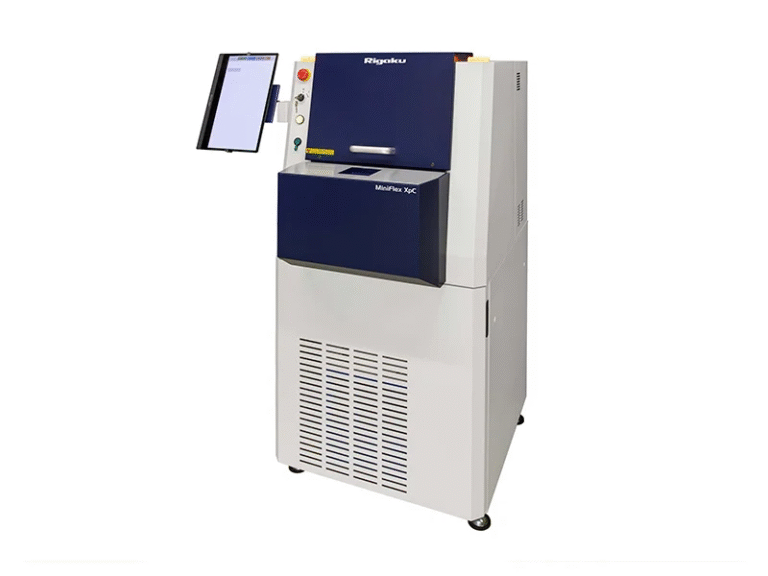
The MiniFlex benchtop X-ray diffractometer is a multipurpose powder diffraction analytical instrument that can determine: crystalline phase identification (phase ID) and quantification, percent (%) crystallinity, crystallite size and strain, lattice parameter refinement, Rietveld refinement, and molecular structure. It is widely used in research, especially in material science and chemistry, as well as in industry for research and quality control. It is the newest addition to the MiniFlex series of benchtop X-ray diffraction analyzers from Rigaku, which began with the introduction of the original MiniFlex XRD system decades ago.
 Supported by LabLinc Studio
MiniFlex Overview
X-ray powder diffraction with HPAD detector
MiniFlex XRD system delivers speed and sensitivity through innovative technology advances, including the HyPix-400 MF 2D hybrid pixel array detector (HPAD) together with an available 600 W X-ray source and new 8-position automatic sample changer.
Hybrid pixel array detector (HPAD)
This new direct photon counting detector enables high-speed, low-noise data collection and may be operated in 0D and 1D modes for conventional XRD analysis and 2D mode for samples with coarse grain size and/or preferred orientation.
XRD accessories enhance your MiniFlex
A variety of X-ray tube anodes—along with a range of sample rotation and positioning accessories, together with a variety of temperature attachments—are offered to ensure that the MiniFlex X-ray diffraction (XRD) system is versatile enough to perform challenging qualitative and quantitative analyses of a broad range of samples, whether performing research or routine quality control. The new (Gen 6) MiniFlex X-ray diffractometer system embodies the Rigaku philosophy of “Leading with Innovation” by offering the world’s most advanced benchtop system for powder diffractometry.
X-ray Seamless Pixel Array detector
The XSPA-200 ER is a compact multidimensional pixel detector for the MiniFlex. The most significant difference between the XSPA-200 ER and the conventional detector for MiniFlex is its high energy resolution. X-ray diffraction patterns measured by XSPA-200 ER have low background intensities because the detector discriminates fluorescent X-rays generated from the sample. The XSPA-200 ER enables the MiniFlex to obtain higher quality measurement data.
Advanced powder diffraction software
Each MiniFlex comes standard with the latest version of SmartLab Studio II, Rigaku's full-function powder diffraction analysis package. The latest version offers important new functionality; including a fundamental parameter method (FP) for more accurate peak calculation, phase identification using the Crystallography Open Database (COD), and a wizard for ab initio crystal structure analysis.
MiniFlex X-ray diffractometer history
The Rigaku MiniFlex X-ray diffractometer (XRD) is historically significant in that it was the first commercial benchtop (tabletop or desktop) X-ray diffractometry instrument. When introduced in 1973, the original Miniflex™ benchtop XRD was about one-tenth the size, and dramatically less expensive, than conventional X-ray diffraction (XRD) equipment of the period. The original instrument (Gen 1), and its successor that was introduced in 1976 (Gen 2), employed a horizontal goniometer with data output provided by an internal strip chart recorder. The third generation (Gen 3) benchtop diffractometer, introduced in 1995, was called Miniflex+. It provided a dramatic advance in X-ray power to 450 watts (by operating at 30kV and 15mA) and Windows® PC computer control. Both the Miniflex+ and the succeeding generations of bench diffractometers employ a vertical goniometer and allow the use of an automatic sample changer. The fourth generation (Gen 4) Miniflex II benchtop XRD was introduced in 2006 and offered the advance of a monochromatic X-ray source and a D/teX Ultra 1D silicon strip detector. The fifth generation (Gen 5) MiniFlex600 desktop XRD, introduced in 2012, built upon this legacy with 600 W of available power and new powder diffraction software.
Applications of the Rigaku MiniFlex
- Materials research. Compare crystalline phases in prepared powders and investigate how they change after processing.
- Mineral phase analysis. Identify crystalline minerals in prepared samples and estimate phase proportions where the method supports it.
- Batch quality control. Compare diffraction patterns between batches to check for changes in phase composition.
Explore other Rigaku instruments.
MiniFlex Features
- New 6th generation design
- Phase identification
- Compact, fail-safe radiation enclosure
- Phase quantification (phase ID)
- Incident beam variable slit
- Percent (%) crystallinity
- Simple installation and user training
- Crystallite size and strain
- Factory aligned goniometer system
- Lattice parameter refinement
- Laptop computer operation
- Rietveld refinement
- Molecular structure
MiniFlex Specifications
| Technique | X-ray diffraction (XRD) | |
|---|---|---|
| Benefit | Phase analysis of poly-crystalline materials | |
| Technology | Benchtop X-ray diffractometer with advanced detector | |
| Attributes | 600 W X-ray tube, D/teX Ultra2 silicon strip detector, accepts unusual samples, tabletop form factor | |
| Options | 8-position autosampler HyPix-400 MF (2D HPAD) detector Graphite monochromator Air sensitive sample holder ShapeFlex sample holder |
|
| Computer | External PC, MS Windows OS, SmartLab Studio-II software | |
| Dimensions | 620 (W) x 722 (H) x 460 (D) mm | |
| Mass | 80 kg (core unit) | |
| Power requirements | 1Ø, 100-240 V 50/60 Hz | |