Product information
Differential Scanning Calorimeter
Characterize heat gain/loss associated with phase transitions
Differential scanning calorimetry (DSC) quantifies the energy changes in reactions such as melting, transition, crystallization and glass transition temperature and is mainly used for research and development; and quality control in the fields of polymer, pharmaceutical.
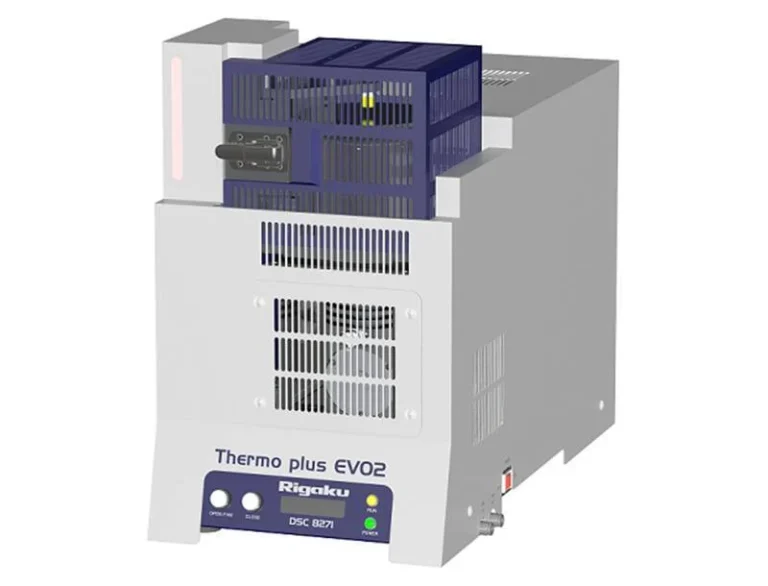
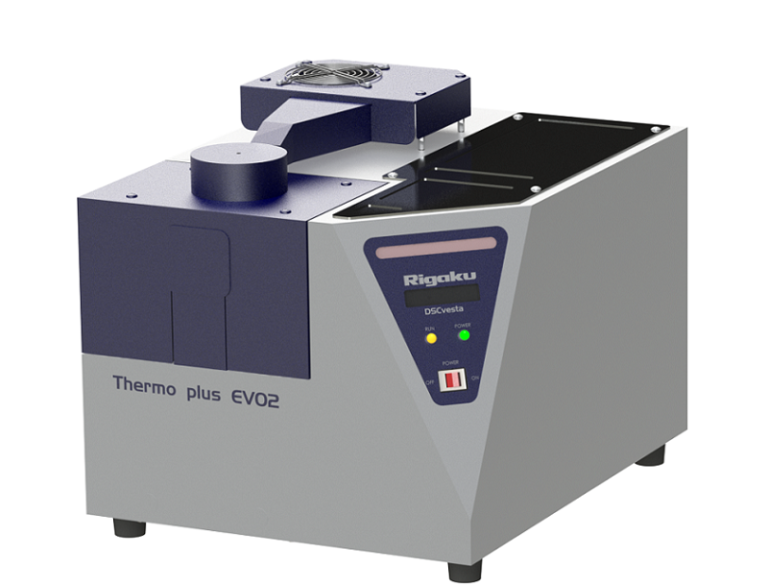
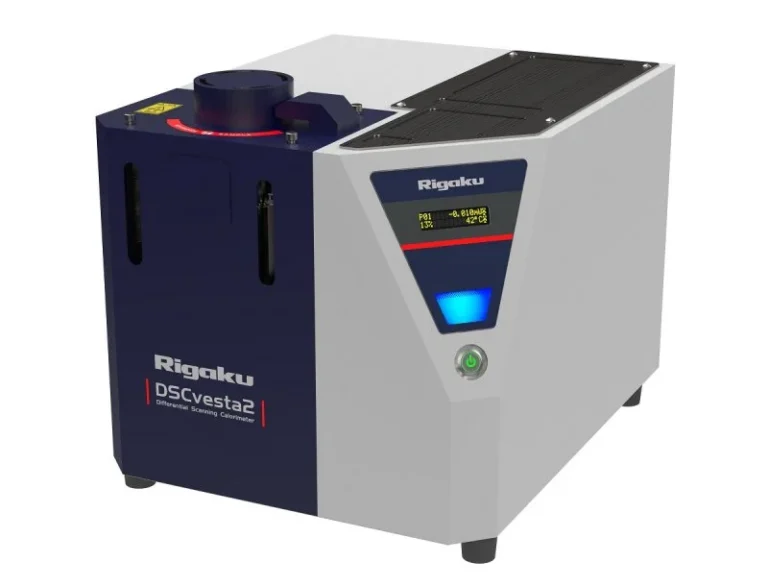
Rigaku’s DSC are heat-flux types. Several models are available depending on the maximum temperature and sensitivity difference.
The high-sensitivity type DSC8231 has several available options, such as a LN₂ cooling system, an automatic sample changer depending on the objective of the measurement.
DSC8231 Features
- High sensitivity, high performance and low noise, realized by a compact furnace
- Quick gas substitution enabled by compact furnace
- Remarkable heating and cooling rates that enhance the efficiency of measurement
- Safety is emphasized on the entire system
- Measuring temperature range: -150°C to 725°C (max. 750°C)
- An optional cooling unit is used for temperatures below ambient
- Inert gas flow is required for temperatures above 500°C
DSC8231 Specifications
| Technique | Differential scanning calorimetry |
|---|---|
| Benefit | Characterize and quantifies the energy of a reaction associated with phase changes |
| Technology | DSC is a thermal analysis technique in which the difference in the amount of heat required to increase the temperature of a sample and reference is measured as a function of temperature |
| Attributes | Using this technique, it is possible to observe fusion and crystallization events as well as glass transition temperatures and can be also used to study oxidation, as well as other chemical reactions |
| Computer | External PC |
| Dimensions | 210 (W) x 310 (H) x 520 (D) (mm) |
| Mass | 15.5 kg (30.5 kg w/ ASC) |
| Power requirements | 1Ø, AC100-120 V/200-240 V 50/60 Hz 5 A |