Tube-above sequential wavelength dispersive X-ray fluorescence spectrometer
Elemental analysis of solids, liquids, powders, alloys and thin films
The Rigaku ZSX Primus IV uses wavelength dispersive X-ray fluorescence (WDXRF) to measure elemental composition. It supports quantitative analysis of major and minor elements across a range from beryllium (Be) to uranium (U), depending on the configuration and measurement conditions. The system can analyse prepared powders, solid samples, alloys, liquids and thin films using methods suited to each sample type.
ZSX Primus IV Overview
ZSX Guidance software for method setup
ZSX Guidance helps operators set up XRF measurements and analyse results. After the operator enters the sample details, target elements and reference standard information, the software uses qualitative spectra to help select measurement lines, background positions and correction settings. The EZ Analysis interface supports routine measurements once a method is set up.
Tube-above optics and light-element analysis
The X-ray tube sits above the sample, which helps reduce the risk of loose powder contaminating the optics. A 30 µm X-ray tube window supports sensitivity for light elements. This design is useful for laboratories that regularly analyse prepared powder samples.
XRF mapping and multi-spot analysis
Optional mapping and multi-spot XRF analysis help show how elements are distributed across a sample. These tools can help assess material uniformity, examine inclusions or compare selected areas. Depending on the measurement setup, the instrument can analyse spots as small as 500 µm.
SQX fundamental parameters and EZ-scan
EZ-scan and the SQX fundamental parameters method support semi-quantitative screening of unknown samples when suitable reference standards are unavailable. SQX applies corrections for effects such as overlapping spectral lines and interactions between elements in the sample.
Nitrogen and helium measurement options
Nitrogen can be used in place of helium for applicable measurements. Rigaku lists an SQX analysis range of phosphorus (P) to curium (Cm) under nitrogen. The SQX scattering fundamental parameters method is unavailable in that atmosphere. Confirm the gas and method requirements for your application when specifying the instrument.
Applications of the Rigaku ZSX Primus IV
- Cement quality control. Measure chemical composition in prepared cement samples. Rigaku has demonstrated the ZSX Primus IV on pressed cement pellets.
- Mining and geological analysis. Screen prepared geological powders and estimate elemental composition using the SQX method.
- Metals and alloy analysis. Measure elemental composition in suitable alloy samples. Optional mapping can help investigate areas where composition varies.
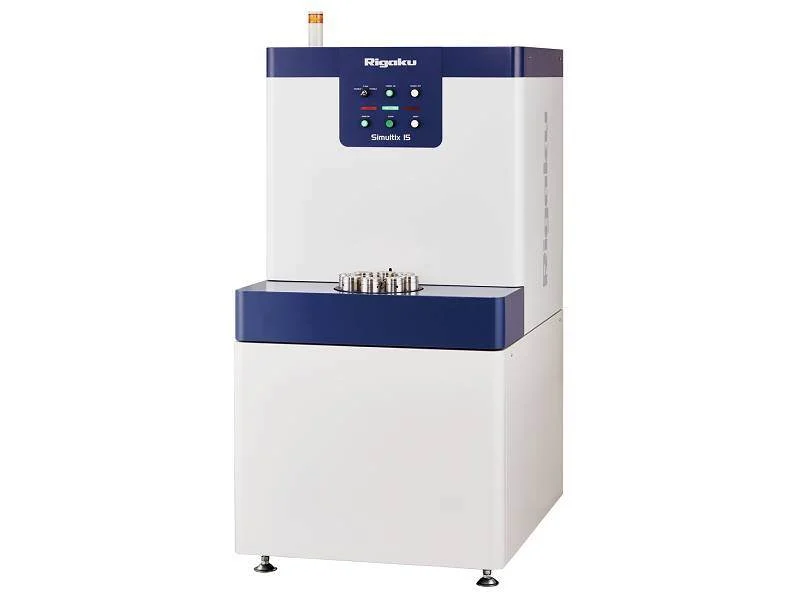
Explore other Rigaku instruments or compare the Simultix 15 simultaneous WDXRF spectrometer for high-throughput process control.
ZSX Primus IV Features
- Analysis of elements from Be to U
- ZSX Guidance expert system software
- Digital multi-channel analyzer (D-MCA)
- EZ Analysis interface for routine measurements
- Tube above optics minimizes contamination issues
- Small footprint uses less valuable lab space
- Microanalysis at spots as small as 500 µm, depending on the setup
- 30μ tube delivers superior light element performance
- Mapping feature for elemental topography/distribution
- Helium seal means the optics are always under vacuum
ZSX Primus IV Specifications
| Technique | Wavelength dispersive X-ray fluorescence (WDXRF) | |
|---|---|---|
| Benefit | Elemental analysis of solids, liquids, powders, alloys and thin films | |
| Technology | Tube-above sequential WDXRF | |
| Attributes | 3 or 4 kW sealed X-ray tube, 48-position autosampler, analyze Be to U, vacuum | |
| Options | He-flush, additional analyzing crystals, r-θ stage/mapping | |
| Computer | External PC, MS Windows OS, ZSX software | |
| Dimensions | 1310 (W) x 1470 (H) x 890 (D) mm | |
| Mass | Approx. 620 kg (core unit) | |
| Power requirements | 1Ø, 200 VAC 50/60 Hz, 8 kW | |