CEN standard sand according to DIN EN 196 Part 1

CEN standard sand according to DIN EN 196 Part 1

Facebook
Twitter
LinkedIn
WhatsApp

Product Details

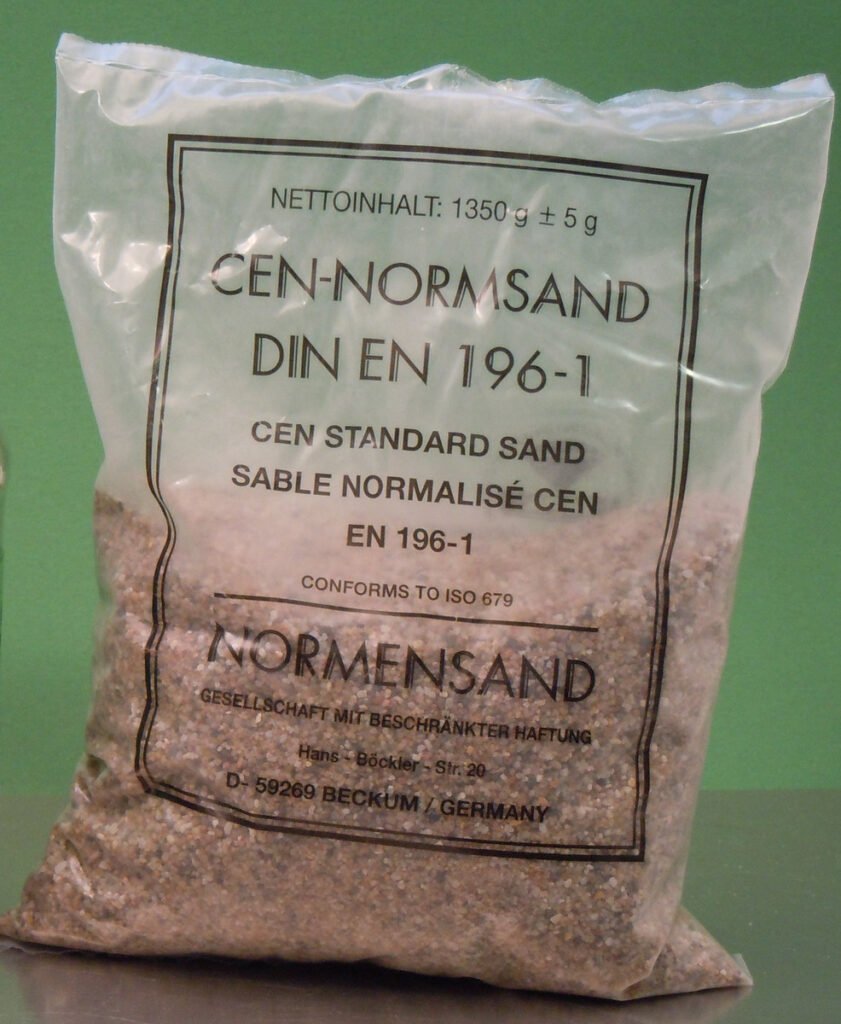
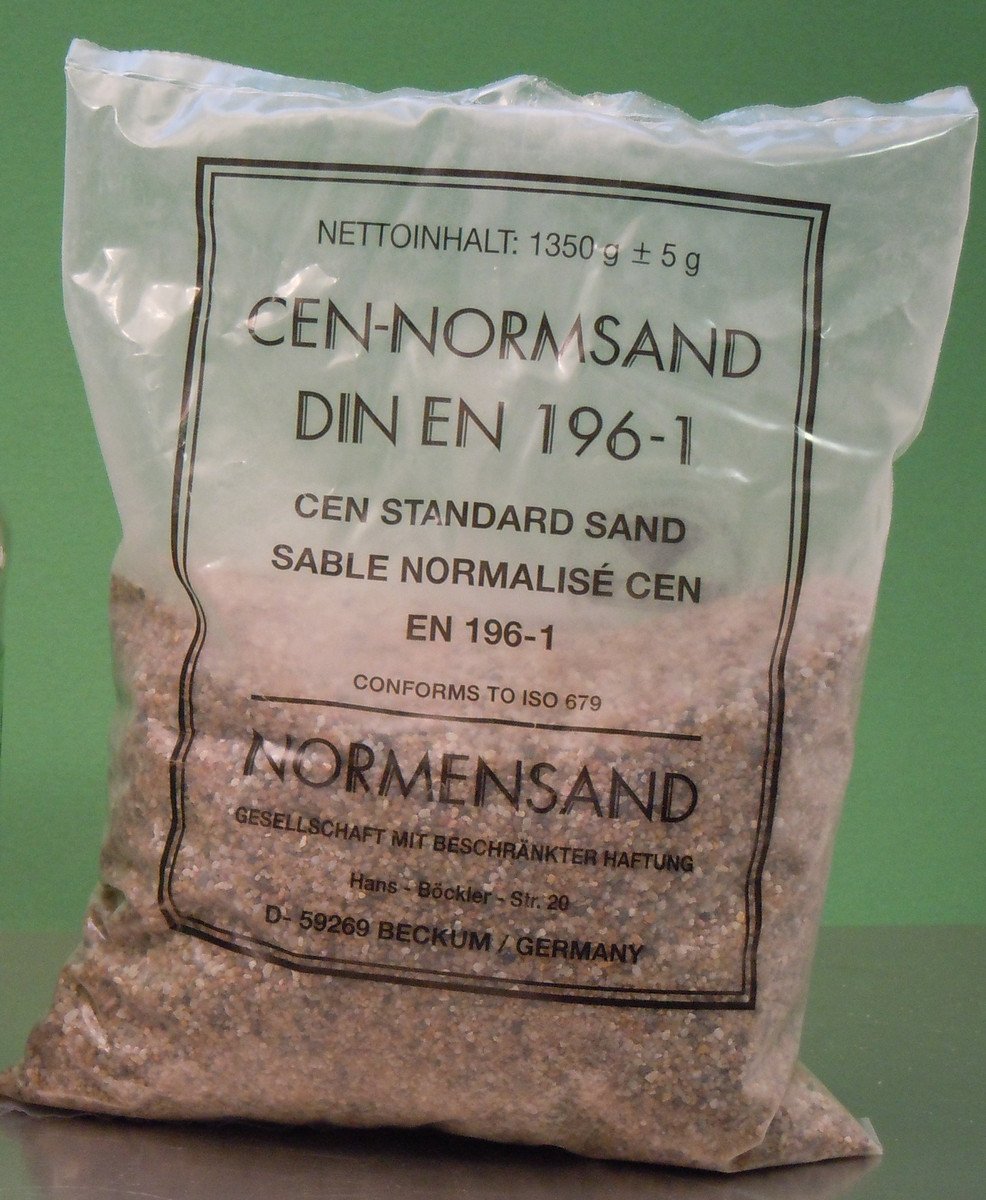
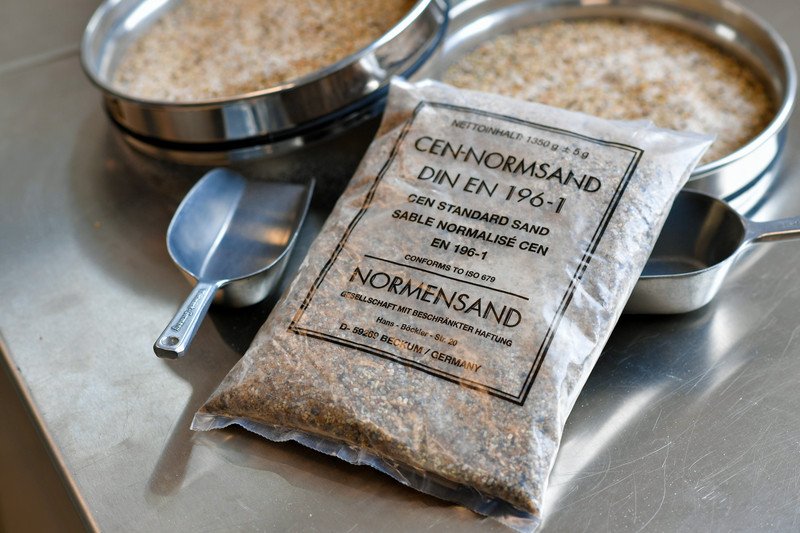
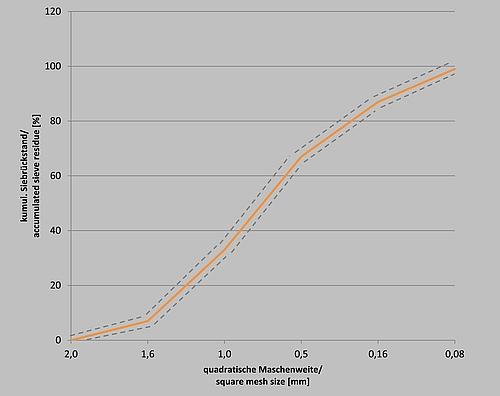
Standard sand according to DIN EN 196-1 is characterized primarily by a specific grain size distribution. The grain sizes range from 0.08 to 2.00 millimeters. Their ratio can be found in the table below. Furthermore, the maximum moisture content of the sand is 0.2 percent. It is packaged in bags weighing 1,350 (± 5) grams. By adding 450 (± 2) grams of cement and 225 (± 1) grams of water, three mortar prisms for testing the standard compressive strength are produced from one bag of standard sand.

Specification

  • Standard: Paper bag with 36 portion bags
  • Portion sachets: 1350 ± 5 g

Particle size distribution range according to DIN EN 196-1
 

Particle size distribution range according to DIN EN 196-1
Sieve (mm) lower limit Interval mean upper limit
2.00 0 0 0
1.60 2 7 12
1.00 28 33 38
0.50 62 67 72
0.16 82 87 92
0.08 98 99 100

Production

Since sand with the particle size distribution required by the DIN EN 196-1 standard does not occur naturally, standard sand must be artificially produced. For this purpose, natural, quartz-rich sands are sieved in several stages to obtain individual fractions of the different particle sizes. The sand fractions are then remixed in defined ratios. The greatest challenge lies in maintaining the required precision and consistency during sieving and subsequent dosing over a very long period. As part of quality control, manufacturers of standard sand are therefore obligated to check and document their production at least once a day to ensure compliance with the required particle size distribution (grading curve). Simultaneously, monthly compressive strength tests (28-day mortar compressive strength) are required. Furthermore, an annual audit is conducted by the responsible certification body.
Relates Products

ROXON’s Belt Condition Monitoring Systems

ROXON’s Belt Condition Monitoring Systems, designed to detect all damages that happen to the surface of conveyor belts avoiding production loss and ensuring safety. Optical 3D scanning • Lasers are creating a “reference line” on the belt surface. • Camera scans the laser profile from its images. • 3D surface

Read More »

Dramituff Standard version

DRAMITUFF is a single component, air setting, castable. It has a very good abrasion resistance, cold crushing strength and chemical resistance. It can be hand packed or rammed in thin lining applications. DRAMITUFF is based on a proven binder system, which allows a wide range of water addition, giving working

Read More »

Anchors for Fibers – Series D

Anchors produces refractory anchors for fibers (for insulating blankets, insulating boards/pannels, modules fibers). The fiber linings are common when we need the lining with good thermal shock resistance and a fast installation. Example : heat treatment furnaces. D1 : “Cerafix” type anchors «CERAFIX» type anchors : Anchors for fibers with

Read More »

Support Brackets – Series C

Anchors produces refractory support brackets. Support brackets are used when the walls of the furnace are high.This enables to spread the weight on the refractory which reduces the risk of deterioration of the wall. They are also often placed around doors or < openings > to reinforce the refractory on

Read More »

Brick Anchors – Series B

Anchors produces refractory anchors for bricks linings. B1 : “BSTP” type anchors BSTP1/BSTP2 : Brick anchors for linings composed of refractory insulating bricks, this type of lining is common in petrochemistry for example.  Download “BSTP”           B2 : “BR” type anchors Anchors for lining on dense

Read More »

Castable Anchors manufacturer – Series A

Anchors produces refractory anchors for castable linings. Our range can suit all applications, We produce refractory anchoring systems in round and flat material, for hand welding, for gun welding, for all types of concrete density. A1 : “CH” type anchors CH1 – CH2 – CH4 – CH1RL : Castable anchor

Read More »