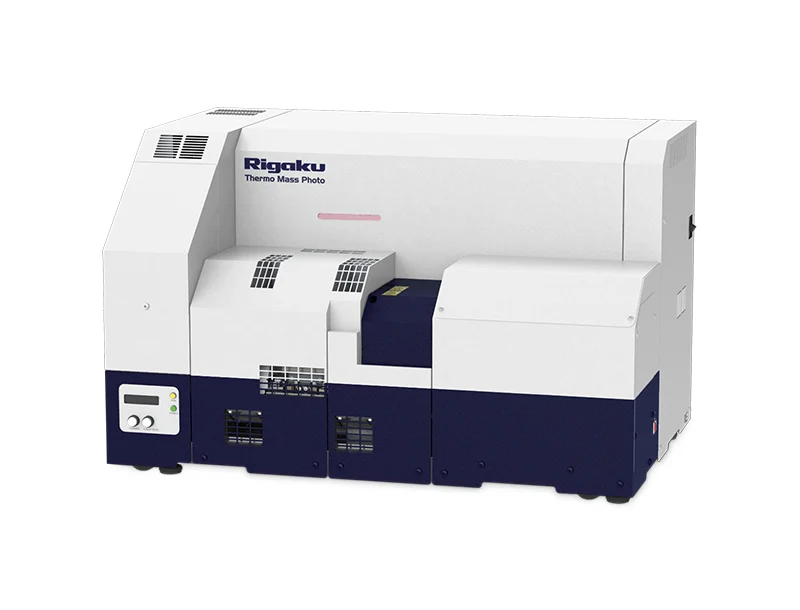
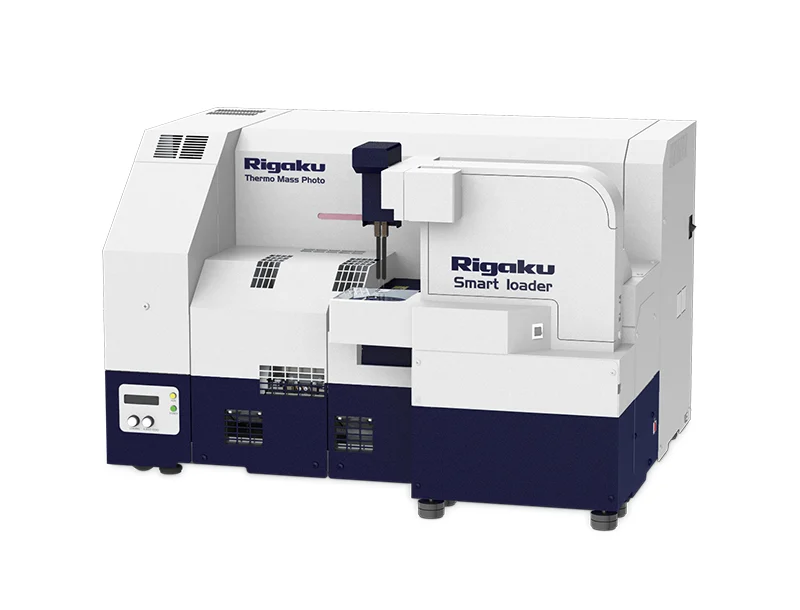
TG-DTA / Photoionization Mass Spectrometer Simultaneous Measurement System
Rigaku has succeeded in integrating the world’s first skimmer-type interface TG-DTA-Mass Spectrometer with fragment-free photoionization technology, which enables the measurement of molecules without destroying them. The combination of an ideal skimmer-type gas introduction interface for high-precision mass analysis of generated gases and fragment-free soft photoionization technology allows real-time discrimination and analysis of gases even when multiple gas components are generated simultaneously.
ThermoMass Photo Overview
Adopting a Breakthrough Ionization technique
Fragment-free PI (photoionization) is introduced to ThermoMass Photo
The soft photoionization technique
When light is irradiated toward a molecule (M), if the photon energy (E = hv) is greater than the ionization energy of the molecule, the molecule releases a photoelectron and becomes ionized.
M+hv → M++e
ThermoMass Photo uses an approximately 10 eV photon energy vacuum UV light as its photo ionization (PI) source.
Ideal gas introduction interface
The skimmer-type interface consisting of a double orifice was developed based on the jet separator principle that enables even high boiling point and highly reactive gases to be detected with high accuracy.
Selectable two ionization modes
Both EI method (electron ionization) and PI method (photoionization) ionization modes can be selected.
Selectable measurement modes depending on the purpose of your measurement
You can select TIC (Total Ion Current) scan mode, which measures the entire specified mass range, or SIM (Selected Ion Monitoring) mode, which measures only the specified mass number with high sensitivity.
Detectable from hydrogen to M/Z 410 with ultrahigh sensitivity
A variety of gases, from inorganic gases with small molecules—such as H₂, H₂O, CO and CO₂—to range of mass number m/z410, can be detected with ultrahigh sensitivity.
Catch unforeseen generated gases with high sensitivity
Standard equipped with High-speed TIC (Total Ion Current) scan mode that detects all generated gases.
Dynamic TG measurement is possible
ThermoMass Photo is capable of examining complex multi-step reactions and translational reactions by simultaneous measurement of MS and the dynamic TG measurement, which has two available two modes: the Stepwise isothermal control (SIA) method, and the Constant velocity reactive control (CRC) method.
All-in-one design
The all-in-one design is safe, saves space, and facilitates easy interface maintenance.
We also have a lineup of dedicated electron impact ionization (EI) instruments. In this case, the measurement mass range (M/Z) is 1 to 200.
User-friendly operability
The measurement software contains a guidance function that significantly improves operability and perform measurements easily.
Software
Degassing behavior can be observed at a glance
The 3D matrix data display can be freely operated from any angle (360° rotation), allowing you to observe degassing behavior over a wide temperature range at a glance.
Easy operation with mouse
You can select and extract two-dimensional mass spectra data at any temperature, or ion chromatograms of any mass number by cursor operation with mouse.
Multiple display of thermal analysis data and MS data
Multiple display of thermal analysis data (TG-DTA) and ion chromatograms can be easily performed by simply “dragging and dropping” the mass number ions with the mouse
Snapshot function
In addition to displaying and manipulating 3D data, a newly added “snapshot function” allows you to manage and store ion chromatograms as bitmap images and extracted mass spectra at any angle and any temperature.
Automated qualitative analysis of mass spectra
Mass spectra selected for any temperature, when linked to the NIST mass spectral library search software (Option), allows qualitative analysis to be performed automatically.
Measurement data from Thermo Plus/Evolved Gas Analyzer Series, Simultaneous Differential Thermogravimetry-Mass Spectroscopy (Thermo Mass) and Temperature Programmed Desorption Gas Analysis (TPD Series) can be loaded and analyzed as is.
Matrix data obtained by combined thermal analysis methods is displayed in easy-to-read 3D, allowing the selection and extraction of 2D data from various angles.
ThermoMass Photo Features
- Adopting of breakthrough ionization technique
- Ideal gas introduction interface
- Selectable two ionization modes
- EI method (electron ionization) and PI method (photoionization)
- Selectable measurement modes upon your purpose of measurement
- TIC(Total Ion Current) scan mode and SIM(Selected Ion Monitoring)mode
- Detectable from hydrogen to M/Z 410 with ultrahigh sensitivity
- Catch unforeseen generated gases with high sensitivity
- Dynamic TG measurement is possible
- Compact space-saving all-in-one design
- Dedicated electron impact ionization (EI) instruments available
- User-friendly operability with guidance function
ThermoMass Photo Specifications
| Product | Thermo plus EVO2 ThermoMass Photo | |
|---|---|---|
| System | TG-DTA/Photoionization Mass Spectrometer ThermoMass Photo | |
| Balance system | Horizontal, differential triple coil system type (TG-DTA) | |
| Skimmer interface principles | Skimmer type, jet separator mounted inside the furnace | |
| Skimmer interface material | Mullite | |
| Measurement temperature range | Room temperature to 1,500°C | |
| Mass spectrometry – analysis method | Quadrupole type mass spectrometer | |
| Mass spectrometry – Mass range (m/z) | 1~410 | |
| Mass spectrometry – Resolution | 1 amu | |
| Mass spectrometry – Detection limit of partial pressure | 1.0×10⁻¹² Pa | |
| Mass spectrometry – Measurement mode | TIC(SCAN) mode, SIM mode (Maximum 16 channels) | |
| Mass spectrometry – Ionization mode | Electron ionization (EI) mode Photoionization (PI) mode (Selectable EI or PI in each measurement.) |
|
| Mass spectrometry – Vacuum exhaust system | Turbo-molecular pump (60L/sec) Rotary pump (135L/min, 50Hz) |
|
| Measurement atmosphere(carrier gas) | He, 20%O₂/He | |
| Options | Automatic sample changer (number of samples: 28, reference: 3, calibration: 5) Sample observation unit |
|
| Dimensions | 870(W) x 547(H) x 576(D) mm 870(W) x 564(H) x 705(D) mm + ASC |
|
| Mass | 98 kg (113 kg + ASC) | |
| Power requirements | 1Ø, AC200 V 50/60 Hz 10 A | |