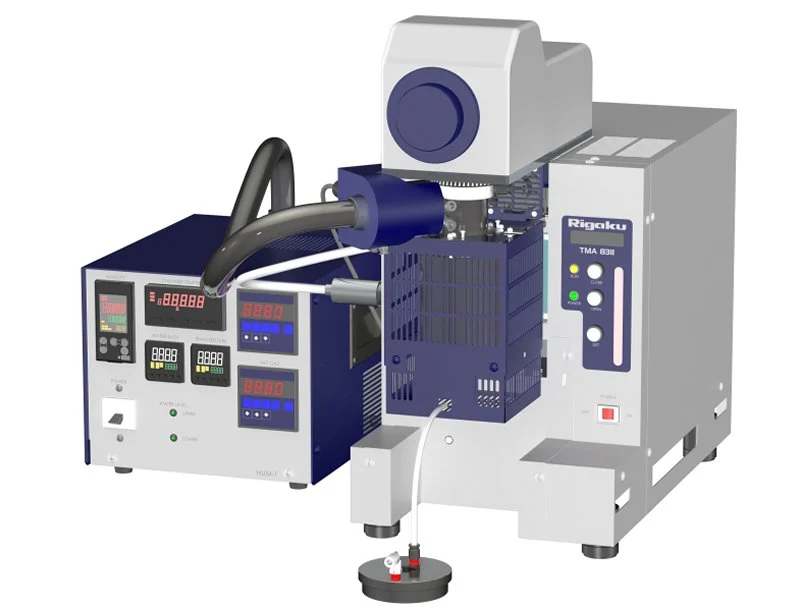
Humidity Controlled TMA
Measurement of mechanical property change with respect to temperature and humidity
TMA/HUM is an instrument where TMA measurements can be carried out in a water vapor atmosphere with a constant relative humidity. In TMA/HUM, TMA is measured at a constant water vapor partial pressure providing a complete understanding of the sample’s expansion or shrinkage with regards to different water vapor partial pressure.
TMA8311/HUM Overview
Especially during sintering of ceramics in a water vapor atmosphere, the actual sintering conditions can be carried out in a laboratory-based environment.
Here TMA measurements held at a constant temperature while changing the relative humidity measure the swelling ratio with regards to relative humidity effective for the sample’s swelling property evaluation.
The humidity generator (HUM-1) uses N₂ base gas to create a water vapor containing a humidity controlled gas to be introduced to the TMA.
Here, the TMA is equipped with a specialized electric furnace that keeps the temperature constant thru a circulator to prevent condensation even at high water vapor concentration atmosphere and can perform measurements at a maximum of 85℃ 90% RH atmosphere. The humidity sensor equipped with a feedback control leads to a stable humidity for longer measurements. Since the relative humidity settings in TMA is integrated in the temperature program, the user can change the relative humidity in each step of the temperature program.
TMA8311/HUM Features
- Humidity control
- High-sensitivity, high-precision measurement by the differential method
- Multi-measurement system that excels in expandability
- Flexible handling of various sample sizes
- Notable enhancement of heating and cooling rates enabled by a compact electric furnace
- Simple sample setting mechanism, the first of its kind in differential TMA
- Compression loading method
- Tensile loading method
- Penetration method
- Differential penetration method
- 3-point bending method
- Single rod compression loading method
- Standard model: Ambient to 1100°C
- High-temperature model: Ambient to 1500°C
TMA8311/HUM Specifications
| Technique | Humidity controlled thermomechanical analyzer | |
|---|---|---|
| Benefit | Measurement of a mechanical property change with respect to temperature and humidity | |
| Technology | Differential expansion principle where the thermal expansion or shrinkage generated from the detection mechanism itself can be canceled | |
| Attributes | Multi-measurement system that excels in expandability | |
| Options | High-temperature model: Ambient to 1500°C | |
| Computer | External PC | |
| Dimensions | 380 (W) x 580 (H) x 580 (D) (mm) | |
| Mass | 30 kg (core unit) | |
| Power requirements | 1Ø, AC100-120V/200-240V 50/60Hz 15A | |