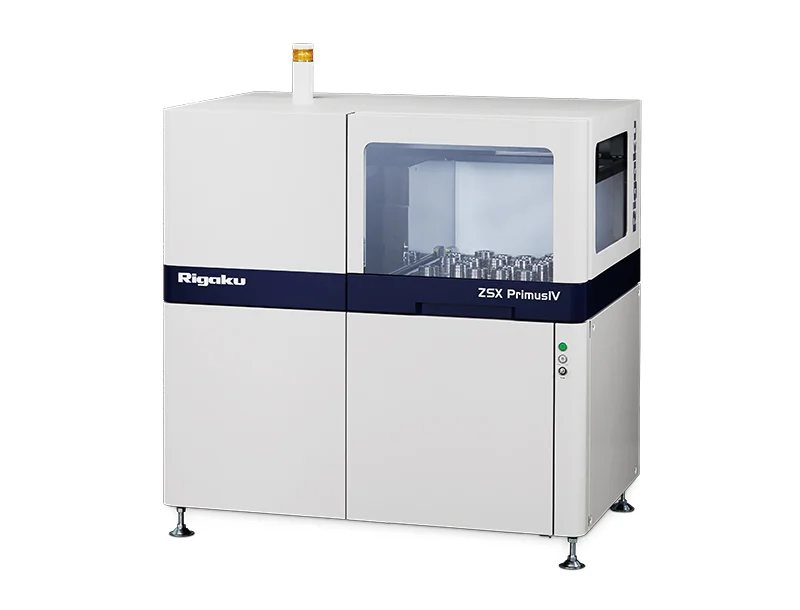
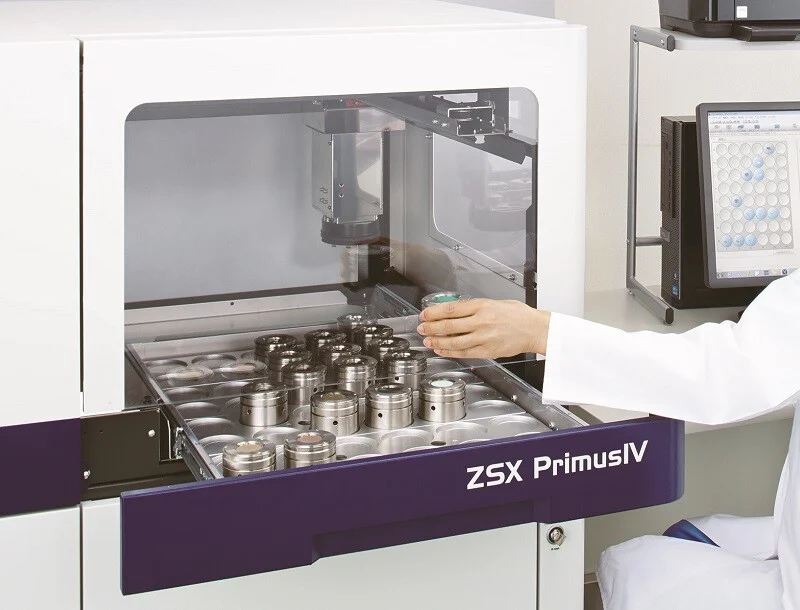
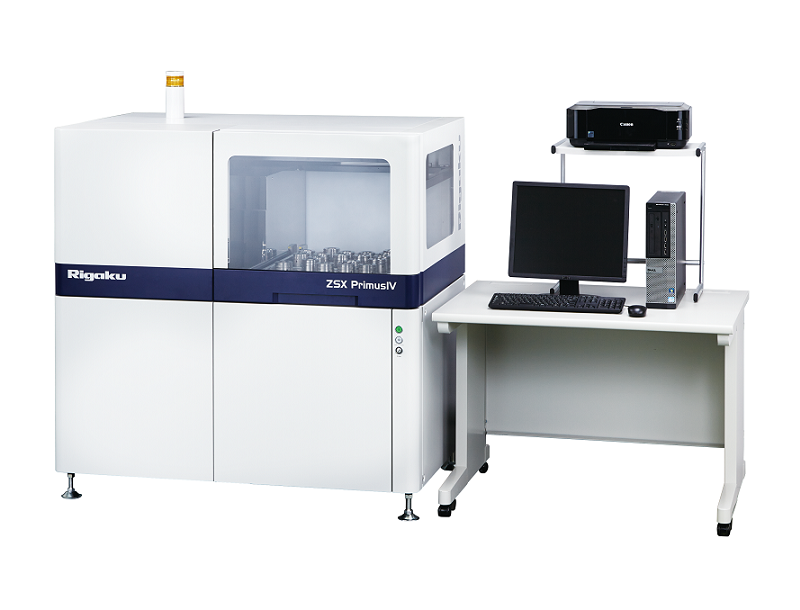
Tube-above sequential wavelength dispersive X-ray fluorescence spectrometer
Elemental analysis of solids, liquids, powders, alloys and thin films
As a tube-above sequential wavelength dispersive X-ray fluorescence (WDXRF) spectrometer, the Rigaku ZSX PrimusIV delivers rapid quantitative determination of major and minor atomic elements, from beryllium (Be) through uranium (U), in a wide variety of sample types — with minimal standards.
ZSX Primus IV Overview
New ZSX Guidance expert system XRF software
ZSX Guidance supports you in all aspects of XRF measurement and data analysis. Can accurate analysis only be performed by experts ? No—that is in the past. ZSX Guidance software, with the built-in XRF expertise and know-how of skilled experts, takes care of sophisticated settings. Operators simply input basic information about samples, analysis components and standard composition. Measured lines with the least overlap, optimum backgrounds and correction parameters (including line overlaps) are automatically set with aid of qualitative spectra.
Exceptional light element XRF performance with inverted optics for superior reliability
ZSX PrimusIV features an innovative optics-above configuration. Never again worry about a contaminated beam path or down time due to sample chamber maintenance. The optics-above geometry eliminates cleaning worries and increases up time. Providing superior performance with the flexibility for analyzing the most complex samples, the ZSX PrimusIV WDXRF spectrometer features a 30 micron tube, the thinnest end-window tube available in the industry, for exceptional light element (low-Z) detection limits.
Mapping and multi-spot XRF analysis
Combined with the most advanced mapping package to detect homogeneity and inclusions, the ZSX PrimusIV allows easy detailed XRF spectrometric investigation of samples that provide analytical insights not easily obtained by other analytical methodologies. Available multi-spot analysis also helps to eliminate sampling errors in inhomogeneous materials.
SQX fundamental parameters with EZ-scan software
EZ-scan allows users to perform XRF elemental analysis of unknown samples without any prior setup. This time saving feature requires only a few clicks of the mouse and a sample name to be entered. Combined with SQX fundamental parameters software, it provides the most accurate and rapid XRF results possible. SQX is capable of automatically correcting for all matrix effects, including line overlaps. SQX can also correct for secondary excitation effect by photoelectrons (light and ultra-light elements), varying atmospheres, impurities and different sample sizes. Increased accuracy is achieved using matching library and perfect scan analysis programs.
Nitrogen or Helium Flush mechanism
Nitrogen gas can now be used as the atmospheric gas in place of helium. When nitrogen gas is used, the SQX analysis range is 15P to 96Cm. When measuring in nitrogen atmosphere, the standard option “SQX scattering FP method” is not applicable.
ZSX Primus IV Features
- Analysis of elements from Be to U
- ZSX Guidance expert system software
- Digital multi-channel analyzer (D-MCA)
- EZ Analysis interface for routine measurements
- Tube above optics minimizes contamination issues
- Small footprint uses less valuable lab space
- Micro analysis to analyze samples as small as 500 µm
- 30μ tube delivers superior light element performance
- Mapping feature for elemental topography/distribution
- Helium seal means the optics are always under vacuum
ZSX Primus IV Specifications
| Technique | Wavelength dispersive X-ray fluorescence (WDXRF) | |
|---|---|---|
| Benefit | Elemental analysis of solids, liquids, powders, alloys and thin films | |
| Technology | Tube-above sequential WDXRF | |
| Attributes | 3 or 4 kW sealed X-ray tube, 48-position autosampler, analyze Be to U, vacuum | |
| Options | He-flush, additional analyzing crystals, r-θ stage/mapping | |
| Computer | External PC, MS Windows OS, ZSX software | |
| Dimensions | 1310 (W) x 1470 (H) x 890 (D) mm | |
| Mass | Approx. 620 kg (core unit) | |
| Power requirements | 1Ø, 200 VAC 50/60 Hz, 8 kW | |