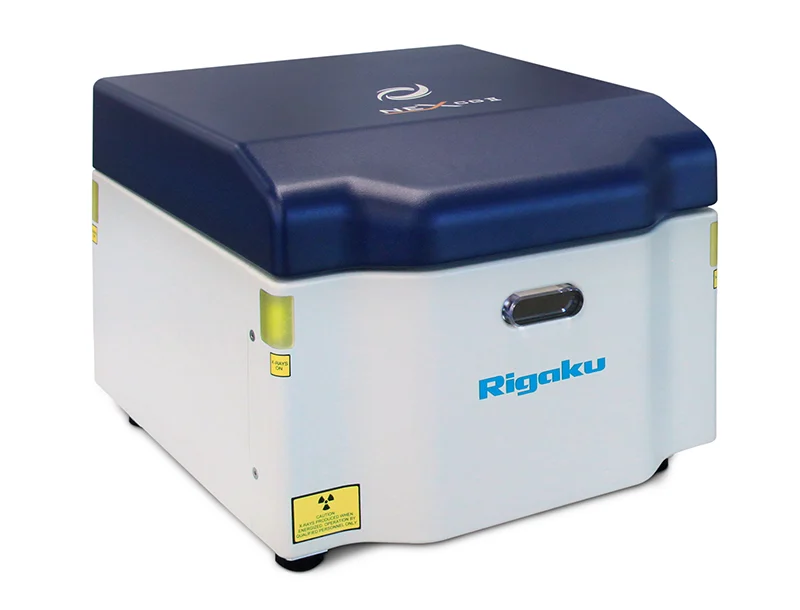
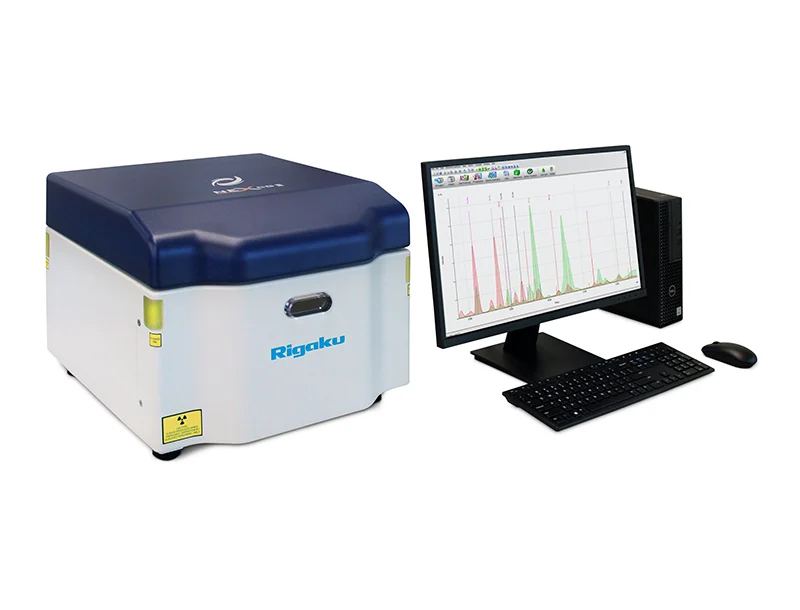
Next-Generation Cartesian Geometry Energy Dispersive X‑ray Fluorescence Spectrometers
Enhanced elemental analysis for industrial quality control to advanced research applications
NEX CG II Series are powerful second-generation energy dispersive X-ray fluorescence (EDXRF) spectrometers that deliver rapid qualitative and quantitative determination of major and minor atomic elements in a wide variety of sample types—from oils and liquids to solids, metals, polymers, powders, pastes, coatings, and thin films.
NEX CG II Series Overview
The Rigaku NEX CG II Series are multi-element, multi-purpose analyzers, ideal for measuring ultra-low and trace element concentrations into the percent levels. These analyzers serve many industries and are especially well-suited for semi-quantitative determination of elemental content in complete unknowns. Applications range from industrial and in-plant quality assurance to research and development. They are easy to use for non-technical operators yet powerful enough for expert use in commercial labs and R&D facilities. Users can achieve the lowest limits of detection and easily manage complex applications. NEX CG II Series are ideal for testing agricultural soils and plant materials, analyzing finished animal feeds, measuring waste oils, environmental monitoring, pharmaceuticals, cosmetics, and many others.
Available models are NEX CG II for excellent spectral resolution for trace peaks or NEX CG II+ for more demanding applications requiring a higher-powered system.
Cartesian geometry and polarization for trace-level sensitivity
NEX CG II Series build on NEX CG’s legacy of using Cartesian Geometry and secondary targets for trace-level sensitivity. NEX CG II Series feature a unique and improved close-coupled Cartesian Geometry optical kernel that dramatically increases signal-to-noise ratio and delivers enhanced elemental analysis.
Unlike conventional EDXRF spectrometers, NEX CG II Series are indirect excitation systems using secondary targets rather than tube filters. Monochromatic and polarized excitation from secondary targets vastly improves detection limits for elements in highly scattering matrices like water, hydrocarbons, and biological materials. Secondary target excitation in full 90° Cartesian Geometry eliminates background noise. As a result, NEX CG II Series bring a new level of analytical sensitivity to XRF technology. Users can measure ultra-low and trace element concentrations, even in challenging sample types.
NEX CG II Series achieve superior analytical power with either a 50 kV 50 W (NEX CG II) or 65 kV 100 W (NEX CG II+) end-window palladium-anode X-ray tube, five secondary targets covering the complete elemental range sodium through uranium (Na – U), and a high-throughput large-area silicon drift detector (SDD). This unique optical kernel, combined with Rigaku’s advanced RPF-SQX Fundamental Parameters software, delivers the most sensitive EDXRF measurements in the industry.
Easy instrument control with advanced qualitative and quantitative analytical software
NEX CG II Series are easy to use with QuantEZ, a powerful PC-based software providing intuitive instrument control with simple menu navigation and a customizable EZ Analysis interface. Users can maximize their time and productivity with simplified routine operations and create their own methods using a simple flow bar wizard. In addition, various software options are available to meet user needs, including SureDI, supporting compliance with 21 CFR Part 11.
Advanced qualitative and quantitative analysis is powered by Rigaku’s RPF-SQX Fundamental Parameters (FP) software, featuring Rigaku Profile Fitting (RPF) technology and Scattering FP. This robust integrated software allows semi-quantitative analysis of almost all sample types without standards—and rigorous quantitative analysis with standards. Rigaku’s Scattering FP method automatically estimates the concentration of unmeasurable low atomic number elements (H to F) and provides appropriate corrections.
Calibration standards can be expensive and difficult to obtain for many applications. With RPF-SQX, the number of required standards is greatly reduced, significantly lowering the cost of ownership and reducing workload requirements for running routine analyses.
NEX CG II Series Features
- Non-destructive elemental analysis for sodium (Na) to uranium (U)
- Quick elemental analyses of solids, liquids, powders, coatings, and thin films
- Indirect excitation for exceptionally low detection limits
- High-power X-ray tubes (50 kV 50 W or 65 kV 100 W)
- Large-area high-throughput silicon drift detector (SDD)
- Analysis in air, helium, or vacuum
- Powerful and easy-to-use QuantEZ software with multilingual user interface
- Advanced RPF-SQX Fundamental Parameters software featuring Scattering FP
- Rigaku Profile Fitting (RPF) advanced algorithm for peak deconvolution
- Various automatic sample changers accommodating up to 52 mm samples
- Low cost of ownership
NEX CG II Series Specifications
| Technique | Indirect excitation energy dispersive X-ray fluorescence (EDXRF) | |
|---|---|---|
| Benefit | Excel in complex applications with trace elements and variable base matrices; analyze solids, liquids, powders, coatings, and thin films | |
| Technology | 3D Cartesian geometry energy dispersive XRF (EDXRF) using a large-area high-throughput silicon drift detector (SDD) | |
| Attributes | High-power X-ray tube (50 kV 50 W or 65 kV 100 W), large-area high-throughput SDD, analyze Na to U | |
| Software | QuantEZ for control of spectrometer functions and data analysis | |
| Options | Vacuum, helium purge, automatic sample changers, sample spinner tray, external PC with Microsoft Windows operating system, UPS, RPF-SQX Fundamental Parameters with Rigaku Scattering FP, SureDI support for 21 CFR Part 11 compliance, other software features | |
| Dimensions | 46.3 (W) x 49.2 (D) x 38.2 (H) cm | |
| Mass | Approx. 65 kg (NEX CG II); approx. 68 kg (NEX CG II+) | |
| Power requirements | 1Ø, 100 – 240 V, 3.8 – 1.6 A (50/60 Hz) or 100 – 240 V, 5.2 – 2.6 A (50/60 Hz) | |
| Warranty | 2 years | |